
Will Chemical Overhaul Damage My Aircon?
How qualified technicians protect coil fins, gaskets, electronics, and insulation during a Full-Dismantle Chemical Overhaul.
Updated:
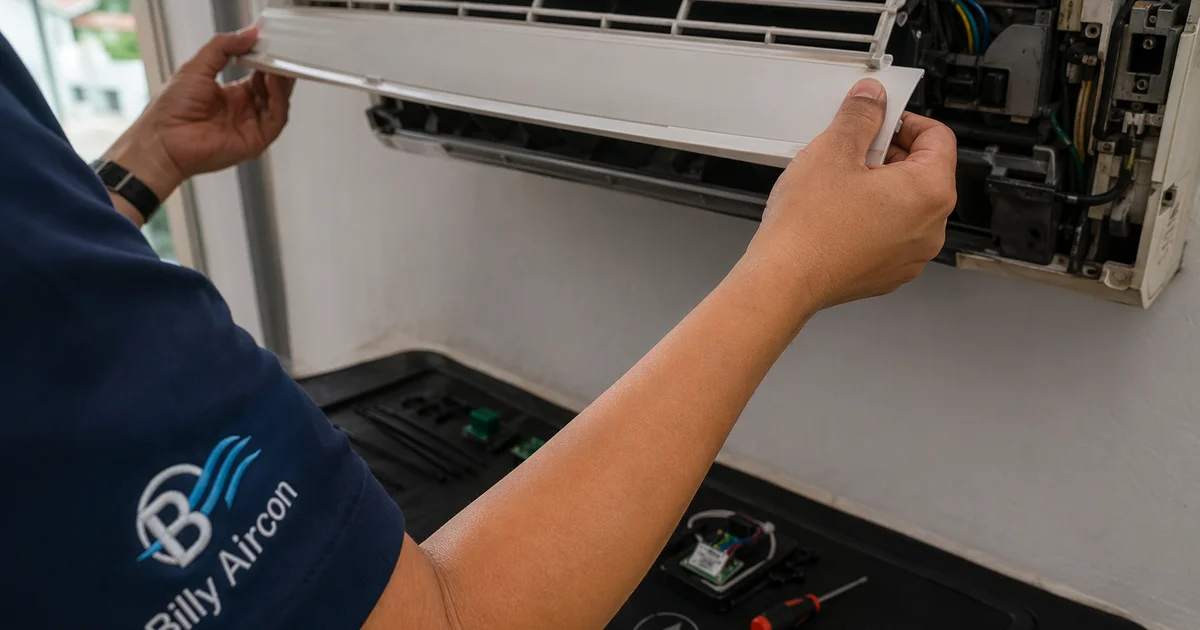
We often hear homeowners ask a simple question: is aircon chemical overhaul safe?
The reality is that the cleaning process determines the safety, not the chemical itself. Top brands like Daikin, LG, and Panasonic explicitly require deep cleaning to maintain cooling efficiency.
Our team has seen exactly what happens when inexperienced contractors take shortcuts.
This guide will break down the precise methods needed to protect your system during an overhaul.
The Short Answer: Is Aircon Chemical Overhaul Safe?
A properly performed Full-Dismantle Chemical Overhaul does not damage your aircon. The unit is designed to be cleaned with chemical detergent, and manufacturer service manuals for Daikin, Mitsubishi Electric, and Panasonic all describe coil chemical cleaning as standard professional servicing.
The actual chemical overhaul aircon damage risk comes from a poor cleaning process rather than the chemical wash procedure itself. Several specific factors determine the safety of your unit.
- Correct chemical pH for the coil material
- Power isolation and electronics removal before any liquid contact
- Insulation inspection and drying before reassembly
- Refrigerant handling by NEA-licensed technicians
- Manufacturer-compliant reassembly torque on flare nuts
We execute all five of these steps on every single overhaul across Singapore. That commitment is exactly why our team confidently offers a 90-day workmanship warranty.
How Coil Fins Are Protected
Aluminum aircon fins are highly sensitive to extreme pH levels on either end of the scale. Acidic cleaners below pH 7, like vinegar or citric acid, actively etch the aluminum.
Strongly alkaline cleaners, such as concentrated lye, will rapidly corrode the metal. Neither extreme is safe for your system.
The Role of Hydrophilic Coatings
Modern air conditioners from LG, Daikin, and Panasonic often feature blue fin or gold fin technology. These special hydrophilic epoxy coatings are applied to the aluminum fins to provide two main benefits:
- Rapid drainage: Water beads off quickly, preventing standing moisture.
- Enhanced efficiency: Clear fins allow for better heat exchange during the cooling cycle.
Using the wrong chemical will strip this protective blue fin coating entirely, leaving the bare metal exposed to rust and salt damage.
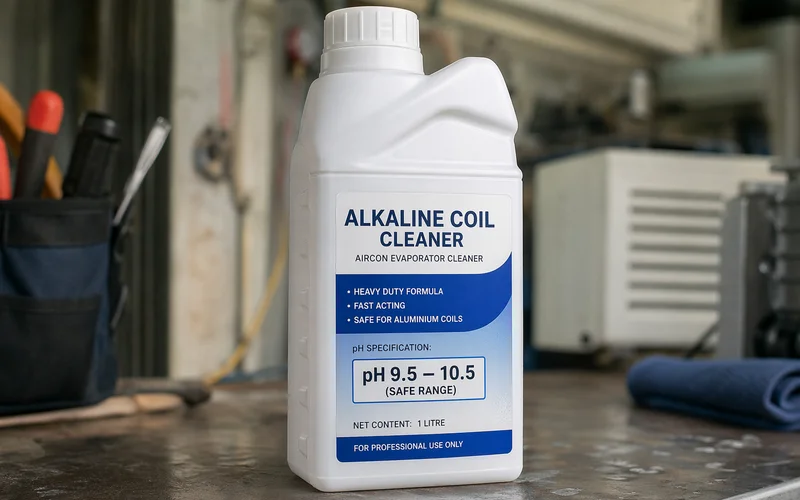
Our custom detergent is mildly alkaline with a pH around 9 to 10, specifically formulated to protect these hydrophilic coatings. It dissolves biofilm by breaking down its protein matrix without attacking the underlying aluminum or the epoxy layer.
The chemical bath soak runs for 25 to 35 minutes. This timeframe is long enough to dissolve the build-up but well within the safe contact time for the metal components.
How Electronics Are Protected
The control board, sensor wiring, fan motor, and capacitors all sit inside the indoor unit. Water dripping onto any of these sensitive parts can cause them to short out or fail outright.
The True Cost of Water Damage
Singapore homeowners often face steep repair bills if electronics are not protected during a wash. Fixing a shorted component easily erases any savings from a cheap servicing job.
| Aircon Component | Estimated Replacement Cost (Singapore) | Risk of Chemical Damage |
|---|---|---|
| Printed Circuit Board (PCB) | S$350 to S$900 | High (Water ingress causes instant short) |
| DC Fan Motor | S$120 to S$250 | High (Moisture corrodes internal bearings) |
| Thermistor / Sensors | S$80 to S$150 | Medium (Chemical residue affects readings) |
Our Electrical Safety Protocol
We follow a strict isolation protocol to prevent these costly repair bills. Skipping any of the steps below creates a massive and unnecessary damage risk.
- Power isolation at the breaker: The unit is fully de-energised before any technician opens the cover.
- Control board removal: The PCB is disconnected and placed on a dry surface far away from the chemical bath area.
- Sensor wiring isolated: Thermistors and wires are kept completely dry throughout the soak phase.
- Fan motor protection: The motor is removed where possible, or tightly wrapped to prevent any liquid contact.
- Strict drying times: Reassembly happens only when components are fully dry, which takes about 5 to 10 minutes of air-drying between the soak and reinstall.
Subcontractors and price-driven providers sometimes skip the control board removal to save time. Our team never takes this shortcut. This guarantees your expensive electronics remain completely safe.
How Insulation Is Inspected
The fan coil unit contains internal foam insulation wrapped around the coil and refrigerant lines. Chemical bath soaks do not damage the insulation directly, but trapped moisture creates severe long-term issues.
Most residential aircons in Singapore use closed-cell elastomeric nitrile foam, like Armaflex Class 1 or Superlon. These premium materials feature a built-in water vapour barrier designed to prevent condensation and maintain a low thermal conductivity of around 0.034 W/m-K.
If this foam gets soaked with water and is not dried before reassembly, you will likely face two major problems:
- Insulation failure: The trapped moisture ruins the foam’s ability to block heat transfer.
- Mould and leaks: Wet insulation leads directly to black mould growth and causes condensation to constantly drip onto your floor.
Our standard process includes a careful inspection of the insulation during every overhaul. Any waterlogged sections are dried fully using industrial blowers or completely replaced if the foam is severely degraded.
Replacement is actually quite rare, as a thorough air-dry usually resolves the issue. This mandatory inspection is one major reason a proper overhaul takes up to two hours rather than a rushed thirty minutes.
How Refrigerant Is Handled
Most overhauls do not require any refrigerant work since the chemical bath focuses on the indoor coil rather than the gas lines. However, a post-wash gas pressure check remains a mandatory part of every overhaul to verify the system is cooling properly.
Singapore’s National Environment Agency (NEA) has tightened regulations around aircon refrigerants for 2026. Older gases like R410A are being phased out in favour of climate-friendly R32, which boasts a much lower Global Warming Potential of 675.
R32 refrigerant is highly efficient but also mildly flammable, requiring certified handling protocols. If your pressure tests low, our technicians will discuss adding a top-up as a separate add-on service.
Common top-up options in Singapore include:
- R22: Found in older legacy systems (costs vary based on declining supply).
- R410A: Standard in units installed before 2022 (typically S$60 to S$120).
- R32: The modern standard for new 5-tick units (typically S$80 to S$150).
Our team includes NEA-certified technicians who have completed the necessary Institute of Technical Education (ITE) safety courses to handle R32 properly.
Signs of a Badly-Done Overhaul
If you had a chemical overhaul elsewhere and worry it was done poorly, there are clear warning signs to watch for. A bad job often leaves physical evidence on the unit itself.
Look for these common indicators of poor workmanship:
- Cooling worse than before: This points to bad reassembly, a clogged drain pan, or disturbed refrigerant lines.
- Visible water marks: Stains on the black Superlon insulation mean moisture was trapped inside.
- Bent or pitted coil fins: Acidic chemicals will strip the blue fin coating and eat into the aluminum.
- Flashing error codes: If your Daikin or Mitsubishi unit flashes lights shortly after the wash, water likely entered the PCB.
- Chemical smells: A sharp, acidic odour persisting for more than a day indicates poor rinsing.
Any of these issues is a valid reason to escalate the matter with your original provider. We can also inspect a recently done overhaul for a fixed assessment fee if you need a professional second opinion.
What Our 90-Day Warranty Covers
If symptoms we treated recur within 90 days as a direct result of our workmanship, we will return to fix the issue at no extra charge. This includes returning smells, weak cooling, leaking water, or returning biofilm.
Parts like a damaged compressor or a faulty PCB carry their own separate manufacturer warranties.
Detail on the warranty terms: 90-Day Workmanship Warranty.
If you are still wondering, is aircon chemical overhaul safe, we want you to feel completely confident in the service you receive. Reach out to our specialists today to schedule your safe and thorough chemical overhaul.
Frequently Asked Questions
Can the chemical damage the coil fins? expand_more
What if a circuit board gets wet? expand_more
Is your chemical NEA-compliant? expand_more
Related Guides
90-Day Workmanship Warranty on Chemical Overhaul — What's Covered
What our 90-day workmanship warranty covers, the claim process, exclusions, and how the receipt and warranty card work.
Chemical Overhaul for Ice on the Evaporator Coil
Why ice forms, why standard servicing won't fix it, and how a Full-Dismantle Overhaul clears the underlying biofilm restriction.
Chemical Overhaul for a Leaking Aircon (Blocked Drain Pan)
Water leaking inside? Sludge blocks the drain pan. How Full-Dismantle Overhaul clears the path with same-day emergency response.
Chemical Overhaul vs Replacing the Aircon — Which Makes Sense?
When Overhaul genuinely restores a unit, when replacement is right. Age cut-offs, cost comparison, and when to stop investing.
Learn more about Chemical Overhaul
WhatsApp us for a same-day chemical wash quote, or call our team directly.