
Chemical Overhaul for Ice on the Evaporator Coil
Why ice forms, why standard servicing won't fix it, and how a Full-Dismantle Overhaul clears the underlying biofilm restriction.
Updated:
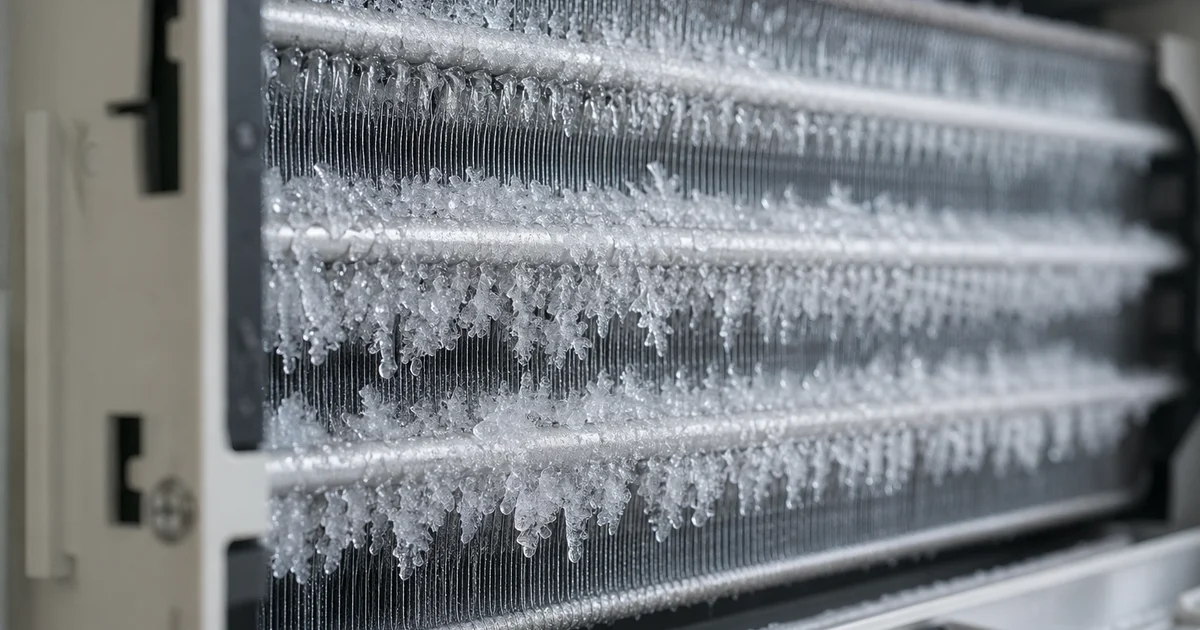
You already know that seeing a thick block of ice on your aircon is never a good sign. From what we observe daily, a frozen coil usually indicates a severe airflow restriction, not just a minor glitch. Our team at Aircon Chemical Wash SG, the dedicated chemical wash division of Billy Aircon operating since 2003 with 26 specialists, handles these emergencies constantly across Singapore.
That sudden ice buildup happens because cold air cannot escape the system fast enough.
Let’s look at the data behind why this occurs and explore the exact chemical overhaul process we use to resolve it.
Why Ice Forms on the Coil
Ice forms when airflow across the cooling components is severely restricted. Your aircon’s evaporator coil normally sits between 7 to 10 degrees Celsius. Refrigerant flows through these pipes, absorbing heat from the room air, and this temperature differential keeps the metal cold but safely above freezing.
Problems begin when dust and moisture block that essential air movement. Singapore averages over 80 percent relative humidity, which means condensation happens constantly inside your unit. We frequently see situations where fine cementitious dust from nearby BTO renovations mixes with this wet condensate. This mixture cures directly on the coil fins, creating a hardened crust that chokes the airflow completely.
With less air moving across the coil, a feedback loop accelerates the freezing process:
- The coil cannot transfer its absorbed cold into the room fast enough.
- Refrigerant temperatures drop significantly further than the manufacturer designed.
- The surface of the coil plunges below zero degrees Celsius.
- Normal condensate water freezes instantly into visible ice on aircon components.
- Ice accumulation further blocks the available airflow.
By the time you notice an aircon coil frozen in your Singapore home, the unit is operating completely outside of its safe specifications. Running the system at the lowest temperature setting during high humidity only forces the evaporator coil to freeze faster.
Switch off the unit
Running an aircon with ice on the coil sends liquid refrigerant back to the compressor instead of vapour. Liquid in the compressor causes mechanical damage. Switch off the unit immediately and book Full-Dismantle Overhaul same-day.
Why Standard Servicing Won’t Fix It
Standard quarterly servicing only clears superficial surface dust, which cannot dissolve the hardened internal buildup causing the actual airflow blockage. It completely misses the sticky, jelly-like biofilm embedded deep within the coil fins.
This biofilm, often called aircon slime, forms when organic debris mixes with moisture. A 2024 microbial study of household air conditioners showed that cooling fins can harbour heavy bacterial loads, sometimes exceeding 6,500 colony-forming units per square centimetre. We often find strains like Acinetobacter and common mold spores trapped inside this thick jelly. Normal water spraying just wets this biological layer without removing it.
Trying to fix a frozen unit with basic cleaning methods usually leads to quick failures:
- Filter replacement alone: The primary blockage remains inside, meaning ice often returns within a few hours.
- Surface fin brushing: Soft brushes cannot penetrate the deep, hardened crust or internal biofilm.
- Refrigerant top-up without chemical wash: Adding gas temporarily masks the symptom, but the ice returns as soon as the airflow restriction reasserts itself.
The only durable fix is completely stripping away the biofilm restriction. This level of cleaning requires a Full-Dismantle Chemical Overhaul.
How Overhaul Resolves Ice
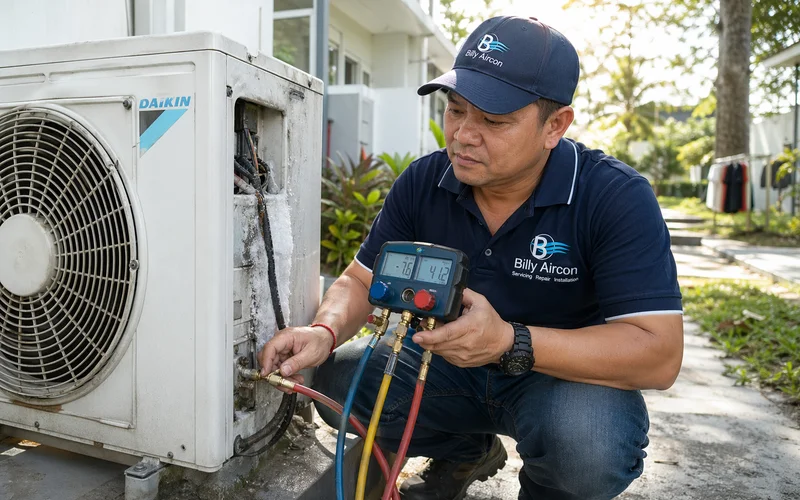
A proper chemical overhaul directly targets and dissolves the specific biofilm and hardened grime causing the airflow blockage. The chemical bath soak safely breaks down the jelly-like coating on the coil fins, restoring the precise fin clearance needed for optimal heat transfer.
Our technicians use specialised alkaline solutions that dissolve organic buildup without degrading the sensitive copper pipes. The immediate results include:
- Restored fin clearance allowing full air volume to pass.
- Refrigerant temperature rising back to the safe 7 to 10-degree Celsius range.
- Immediate cessation of ice formation on the metal surfaces.
- Condensate draining normally through the unblocked drain pan.
You do not have to guess if the blockage is gone. We run the unit post-overhaul and verify the exact output using a digital anemometer placed at the air outlet.
Restored airflow is typically 30 to 50 percent higher than the pre-overhaul reading on iced units. Industry data consistently shows that thoroughly cleaning the evaporator coil and blower wheel enhances overall cooling performance by up to 30 percent, saving significant electricity in the process.
When Refrigerant Is the Real Problem
In roughly 20 percent of cases, a frozen coil points to a refrigerant issue rather than a biofilm blockage. If the system lacks the correct amount of gas, the pressure drops too low, which forces the evaporator coil temperature below freezing.
Most new residential installations in Singapore now use R32 gas. This single-component refrigerant operates at a higher working pressure than older blends, typically ranging between 174 and 377 Psi. We test the specific gas pressure during every single overhaul to ensure it meets these standards.
A pressure drop rarely happens without a physical reason:
- Gas leak: Refrigerant slowly escapes through a degraded flare nut or a loose connector pipe.
- Original undercharge: The unit was installed initially without enough gas for the piping length.
- Failed expansion valve: The mechanical component regulating the actual refrigerant flow is broken.
If the chemical work alone restores the normal cooling cycle, the system does not need additional gas. When pressure tests low after the overhaul, we explain the available gas top-up options (R22, R410, R32) and quote the exact cost separately as part of the Full-Dismantle Chemical Overhaul scope.
Emergency Booking for Iced Units
We treat any ice formation on a cooling coil as a strict emergency call requiring immediate intervention. A melting block of ice produces a massive volume of water that quickly exceeds the capacity of standard HDB and condo drain pans.
This sudden overflow causes immediate water damage to your walls, peeling paint, and ruined plaster. Our operation includes two dedicated emergency teams covering same-day responses for severe leaks, ice buildup, hazardous mould outbreaks, and no-cooling situations.
Taking immediate action protects your compressor from further mechanical stress while you wait for assistance:
- Turn off the main power switch to the aircon immediately.
- Place dry towels beneath the indoor unit to catch the inevitable melting ice.
- Keep the unit completely off until a technician arrives.
- WhatsApp +65 9456 0875 with the exact phrase “ice on coil” to secure priority routing.
Running a frozen unit just adds strain to the compressor and does not improve the room temperature.
Booking Detail
Finding the right solution requires understanding the exact condition of your system.
For the full Overhaul process detail, see What Happens During a Chemical Overhaul.
Addressing the root cause early prevents minor pressure drops from becoming major repair bills.
For confirmation that an Overhaul is the right call before booking, see Signs Your Aircon Needs an Overhaul.
Do not wait until the aircon ice on evaporator coil damages your compressor. Reach out to our team today to schedule your diagnostic check and get your system running smoothly again.
Frequently Asked Questions
Is ice always a chemical wash problem? expand_more
Can I run the aircon with visible ice? expand_more
Do I need both overhaul and gas top-up? expand_more
Related Guides
90-Day Workmanship Warranty on Chemical Overhaul — What's Covered
What our 90-day workmanship warranty covers, the claim process, exclusions, and how the receipt and warranty card work.
Chemical Overhaul for a Leaking Aircon (Blocked Drain Pan)
Water leaking inside? Sludge blocks the drain pan. How Full-Dismantle Overhaul clears the path with same-day emergency response.
Chemical Overhaul vs Replacing the Aircon — Which Makes Sense?
When Overhaul genuinely restores a unit, when replacement is right. Age cut-offs, cost comparison, and when to stop investing.
How Long Does an Aircon Chemical Overhaul Take Per Unit?
Per-unit and multi-unit timing for a Full-Dismantle Overhaul. What extends the job and what shortens it.

Learn more about Chemical Overhaul
WhatsApp us for a same-day chemical wash quote, or call our team directly.