
Chemical Overhaul vs Replacing the Aircon Unit
When Overhaul genuinely restores a unit, when replacement is right. Age cut-offs, cost comparison, and when to stop investing.
Updated:
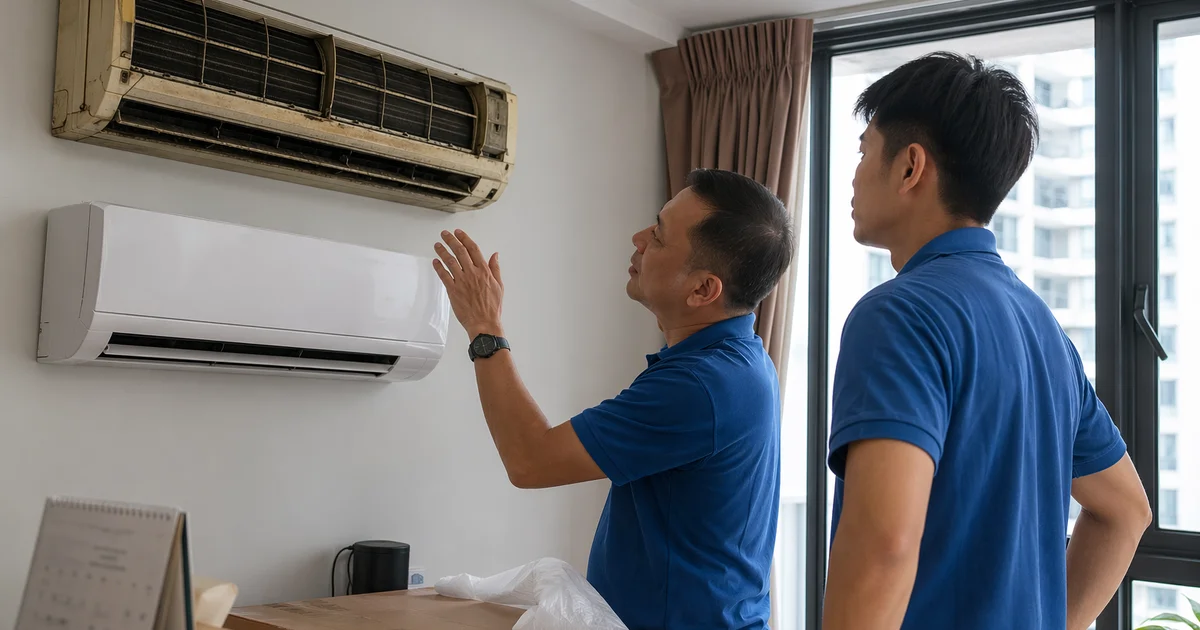
As an industry veteran, I often see perfectly good systems written off prematurely when homeowners research an aircon chemical overhaul vs replacement. It usually happens when service providers lack the capability to perform a deep chemical restoration. They recommend replacing the entire system simply because their basic cleaning methods fall short.
This trend is incredibly frustrating for homeowners facing massive bills. Many units written off as unfixable can actually be saved with the right approach.
Let us look at what the diagnostic data actually tells us about your system’s health, and then outline a practical framework for deciding between an old aircon overhaul or a complete system replacement.
The Honest Decision Framework
The decision to overhaul or replace an aircon depends entirely on the health of its compressor. A healthy compressor means the unit can be fully restored through a chemical overhaul, saving you thousands of dollars.
Providers without advanced chemical cleaning capabilities often default to recommending replacements. They do this because they simply cannot clear the deep-seated grime themselves. Our dedicated chemical wash division at Billy Aircon has seen this exact scenario countless times since we started in 2003. We successfully restore nearly 100% of units previously condemned by others, provided the compressor tests well.
The logic here is straightforward and based on how these machines are built. A standard Fan Coil Unit (FCU) contains several core components:
- Evaporator coils
- Blower wheels
- Drain pans
- Directional fins
Every single one of these parts can be cleaned and fully recovered. The compressor is the only internal part that truly justifies booking an aircon replacement Singapore service once it fails. Replacing a compressor in popular residential brands like Daikin or Mitsubishi often costs between S$600 and S$1,000 today. Paying that much for a single repair rarely makes financial sense compared to upgrading.
When Overhaul Restores the Unit
A Full-Dismantle Chemical Overhaul genuinely restores function when the core mechanics remain intact. This process is highly effective because it removes a stubborn layer of bacteria and mould known as biofilm. Standard water washing simply cannot penetrate this biofilm layer.
You should consider this extensive service when your system meets these specific technical criteria:
- Compressor tests healthy: It runs at the correct pressure and starts smoothly without mechanical noise.
- Refrigerant lines intact: There are no significant leaks and all connectors remain sound.
- Coil fins structurally intact: The fins are not severely corroded or heavily pitted.
- Electronics functional: The control board responds properly and sensors read temperatures correctly.
- Fan motor healthy: The indoor blower motor starts and runs at its expected RPM.
We use professional-grade diagnostic tools like Fieldpiece digital manifolds to verify these conditions before starting any work. Precise pressure readings confirm the system can still operate efficiently. A thorough chemical overhaul takes about 1.5 to 2 hours per unit, requiring the technician to completely dismantle the indoor equipment.
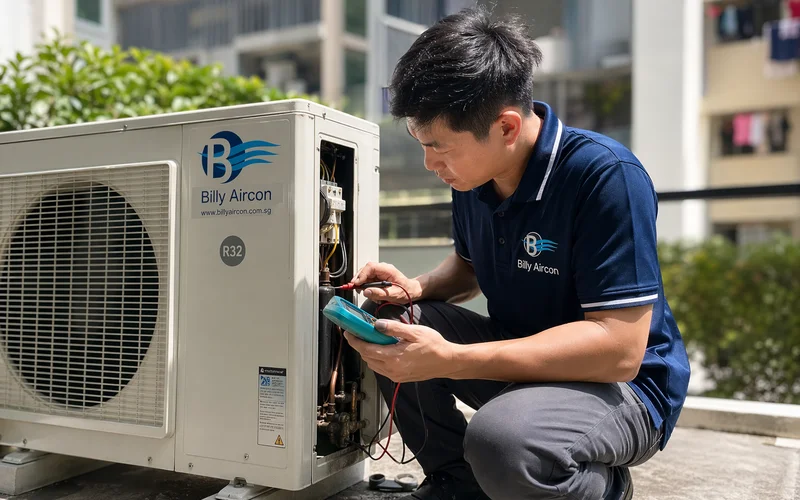
Under these healthy conditions, an overhaul restores the unit to near-new performance for roughly S$130. Buying and installing a new system will set you back anywhere from S$1,500 to S$3,000. The economics strongly favour restoration when the hardware is fundamentally sound.
When Replacement Is the Right Call
Replacement is the honest, necessary answer when the compressor is failing or the unit suffers from irreparable structural damage. Continuing to repair a fundamentally broken system will only waste your money in the long run.
Several distinct scenarios make a new installation the smarter long-term choice.
- Compressor tests weak: The unit runs out of specification, fails on startup, or makes loud grinding noises.
- Unfixable refrigerant leaks: The system suffers continuous gas loss from a leak hidden deep inside the walls.
- Obsolete models: The manufacturer no longer supplies spare parts for your specific aircon model.
- Poor energy efficiency: Older 3-tick NEA-rated units cost significantly more to run than modern 5-tick models.
- Severe physical damage: The coil fins are extensively corroded or the internal structural plastics are cracked.
Our team will always tell you upfront if an overhaul will only act as a temporary bandage. An old, inefficient unit can become a serious financial drain due to Singapore’s high electricity tariffs.
Upgrading to a 5-tick NEA (National Environment Agency) rated system reduces energy consumption by up to 33% compared to a basic 3-tick model. This efficiency upgrade easily saves an average HDB household between S$200 and S$400 over a few years. These recurring savings often justify the initial purchase price of a new system.
Age Cut-Off Guidelines
Age is an important factor, but the condition of the compressor is always the definitive deciding metric. The average lifespan of a well-maintained residential aircon in Singapore is roughly 7 to 10 years.
We use a structured age framework to guide our initial recommendations for residential units.
| Age | Typical recommendation |
|---|---|
| 0 to 8 years | Overhaul if biofilm causes issues; the unit has significant life left. |
| 8 to 12 years | Overhaul is almost always viable; it provides 3 to 5 more years of service. |
| 12 to 15 years | Overhaul is viable if the compressor tests perfectly healthy; otherwise consider replacing. |
| 15+ years | Compressor testing is absolutely critical; many units still restore successfully. |
Older systems also typically use outdated refrigerants like R22, which are no longer the standard. Modern units use R32 or R410A gases, making them much easier and cheaper to service. Our specialists always weigh these maintenance factors during the pre-overhaul inspection.
Cost Comparison
Replacing a system costs significantly more upfront, but understanding the amortised yearly cost helps clarify the true financial impact. With current SP Group electricity tariffs hovering near 30 cents per kWh in 2026, energy efficiency plays a massive role in your household budget.
Let us compare the estimated financial breakdown of your main choices.
| Option | Cost | Expected remaining life |
|---|---|---|
| Full-Dismantle Chemical Overhaul | S$130 to S$180 | 3 to 5 years additional |
| New standard split unit + installation | S$1,500 to S$3,000 | 10 to 15 years |
| Premium inverter unit + installation | S$2,500 to S$4,500 | 12 to 18 years |
Breaking down these expenses per year reveals a clear winner for short-term budget preservation.
- Overhauled 12-year unit (restored to 15 to 17 year total life): S$30 to S$40 per year
- New standard unit: S$150 to S$200 per year amortised
- New premium inverter unit: S$200 to S$300 per year amortised
Overhauling is almost always the lower cost per year by a wide margin. Replacement only wins the mathematical argument when you specifically want upgraded energy efficiency or modern smart home features.
The 100% Restoration Rate Claim
Our 26-person team tracks our restoration success rate closely because it sits at the core of our service promise. This high success rate entirely depends on a sound pre-overhaul compressor test. We successfully restore close to 100% of the units that other local providers have quoted as needing total replacement.
The remaining handful of units we cannot save are genuine compressor failures. We maintain this track record by using advanced alkaline cleaning solutions that safely strip away hardened grime without damaging the delicate copper coils.
Reputations are built on honest, verifiable recommendations. Dishonest advice only generates warranty claims and frustrated customers.
How We Make the Recommendation
Our technicians rely on precise instrument testing to make an honest recommendation about your equipment. The pre-overhaul inspection includes a rigorous set of technical checks.
- Compressor pressure test: We measure standing and running pressure using digital manifolds.
- Electrical insulation check: We utilise a megohmmeter to safely apply 1000V and test the compressor’s internal insulation.
- Startup noise check: We listen for grinding or unusual mechanical vibrations.
- Refrigerant line inspection: We check for signs of oil residue indicating a gas leak.
- Fin and structural check: We look for severe rust or brittle plastics.
If all these components pass the test, we will recommend an overhaul and explain the expected outcome. We immediately outline replacement options at different budget points if the compressor fails. You retain full control over the decision, and our team only executes the work you explicitly sign off on.
If your unit is struggling to keep your home cool, book a diagnostic test with our technicians to find out exactly what it needs. For a detailed breakdown of the deep cleaning process itself, see What Happens During a Chemical Overhaul.
Frequently Asked Questions
Can a 12-year-old aircon be saved by overhaul? expand_more
What percentage of 'needs replacement' units are actually restorable? expand_more
Is overhaul worth it if the unit is 15+ years old? expand_more
Related Guides
90-Day Workmanship Warranty on Chemical Overhaul — What's Covered
What our 90-day workmanship warranty covers, the claim process, exclusions, and how the receipt and warranty card work.
Chemical Overhaul for Ice on the Evaporator Coil
Why ice forms, why standard servicing won't fix it, and how a Full-Dismantle Overhaul clears the underlying biofilm restriction.
Chemical Overhaul for a Leaking Aircon (Blocked Drain Pan)
Water leaking inside? Sludge blocks the drain pan. How Full-Dismantle Overhaul clears the path with same-day emergency response.
How Long Does an Aircon Chemical Overhaul Take Per Unit?
Per-unit and multi-unit timing for a Full-Dismantle Overhaul. What extends the job and what shortens it.

Learn more about Chemical Overhaul
WhatsApp us for a same-day chemical wash quote, or call our team directly.